If you are curious about BDSM, Pet Play or any other kink, exploring new interests, or simply trying to understand your own boundaries better, a Yes/No/Maybe list is a useful place to start.
At its simplest, it is a list of BDSM activities, kinks, roles, and dynamics that you work through one by one. For each item, you decide whether your current answer is Yes, No, or Maybe.
It sounds basic, but that simplicity is exactly what makes it useful. Instead of trying to answer a huge question like “What am I into?”, you can consider specific things individually. You may discover clear interests, definite boundaries, and quite a few things you simply haven’t made your mind up about yet.
A Yes/No/Maybe list can also be used as a BDSM boundary list or kink negotiation tool with a partner. But you don’t need to be in a relationship or dynamic to benefit from one. It can be just as useful when you are exploring on your own.
What Is a BDSM Yes/No/Maybe List?
A BDSM Yes/No/Maybe list is a checklist containing different activities, types of play, relationship dynamics, roles, sensations, and other kink-related interests.
You generally give each item one of three answers:
- YES: I’m interested in this or already know that I enjoy it.
- NO: I don’t want to explore this.
- MAYBE: I’m curious, uncertain, or would consider it under particular circumstances.
The answers themselves are useful, but the interesting part often comes afterward.
Why did you choose Maybe rather than Yes? Is it because you don’t know enough about the activity yet? Would you be interested with someone you trusted but uncomfortable trying it casually? Does the idea appeal to you as a fantasy but not necessarily as something you want to experience?
Those distinctions matter. The same applies to a Yes. Marking something Yes doesn’t mean “Anyone can do this with me whenever they want.” You may still have conditions around the person, setting, intensity, mood, or circumstances.
A checklist records your interests. It does not replace consent.
Why Use a Kink Checklist?
One of the hardest questions to answer when you are new to BDSM is also one of the most common:
“So, what are you into?”
Sometimes you genuinely don’t know yet. You may have a few fantasies or know that certain dynamics appeal to you, but translating that into specific interests and boundaries can be surprisingly difficult. A kink checklist gives you something concrete to respond to instead of expecting you to come up with everything yourself.
It can help you:
- Discover interests you hadn’t considered. Sometimes seeing something written down is what makes you stop and think about it.
- Separate fantasy from reality. Something can be exciting to imagine without being something you actually want to experience.
- Identify boundaries. You start building a clearer picture of what is and isn’t comfortable for you.
- Notice conditions around your interests. You might realize that some activities depend heavily on trust, intensity, or the person involved.
- Make conversations with partners easier. Instead of starting from a blank page, you already have specific topics to discuss.
It is also completely normal to end up with a lot of Maybes, particularly if you are new to kink. You don’t need an immediate opinion about everything.
What Does “Yes” Actually Mean?
A Yes means that you are interested in an activity or already know that you enjoy it.
It does not automatically mean unconditional consent. For example, you might mark an activity Yes but still think:
Yes, but only with someone I trust.
Yes, but I prefer a low intensity.
Yes, but not every time.
Yes, but I need to discuss it beforehand.
That information can be more valuable than the original checkmark.
When I look at a Yes/No/Maybe list, I don’t see the Yes column as a menu of things someone can automatically do. I see it as a list of things worth discussing further.
What Does “No” Mean?
No is the simplest category. It means you don’t want to do it.
You don’t need to turn every No into a debate or provide an elaborate explanation for why something doesn’t appeal to you. Sometimes you will have a very specific reason. Other times, you simply aren’t interested.
Both are valid boundaries.
If you are completing a Yes/No/Maybe sheet with a partner, No should be treated as useful information rather than a disappointment that needs to be negotiated away.And your No is allowed to change over time, just as a Yes is. Changing your mind later doesn’t make the original boundary any less valid.
Why “Maybe” Is Often the Most Interesting Answer
I think Maybe is where these lists become particularly useful. A Maybe isn’t necessarily uncertainty in the sense of “I can’t decide.” It often means that something else needs to be established first.
For example:
- Maybe, but I need to understand it better.
- Maybe, with someone I trust.
- Maybe, at a low intensity.
- Maybe in fantasy, but I’m not sure about reality.
- Maybe, but I would want to discuss safety first.
- Maybe, just not right now.
If you have a lot of Maybes, don’t rush to turn them into Yes or No answers. Instead, look at what is behind them. Sometimes you need more information. Sometimes you need experience. And sometimes something can simply remain a Maybe.
How to Use a Yes/No/Maybe Sheet With a Partner
This is probably the best-known use for a BDSM checklist. You and your partner complete your lists separately and then compare them. Doing them independently first is important because it gives each person a chance to answer without being influenced by the other’s choices.
When you compare your answers, start with the obvious overlaps.
Two Yes answers can reveal shared interests. A No immediately establishes something that is off the table. Two Maybes can lead to a useful conversation about what each person would need before considering something.
Differences are useful too. If one person marks Yes and the other marks Maybe, the conversation shouldn’t be about convincing the Maybe to become a Yes. Ask what the Maybe means instead. Perhaps they are curious but inexperienced. Perhaps they would need a different intensity. Perhaps they don’t know enough about the activity yet.
And if one person says No, that’s where that particular discussion ends.
A kink negotiation tool works best when the goal is understanding each other rather than producing as many matching answers as possible.A kink negotiation tool works best when the goal is understanding each other rather than producing as many matching answers as possible.
Can You Use a Kink List If You’re Single?
Absolutely.
In fact, completing one by yourself can be a useful form of kink self-exploration because nobody else’s preferences are influencing your answers. Go through the list and pay attention not only to individual activities but also to patterns.
Perhaps most of your Yes answers involve power exchange. Maybe you are interested in sensory experiences but not particularly interested in pain. You might notice that roleplay interests you more than physical activities, or that you like the idea of structure, rules, service, praise, restraint, pet play, or another particular dynamic.
Those patterns can tell you much more than one isolated answer.
It can also help you recognize the difference between what sounds interesting, what you fantasize about, and what you genuinely want to try. Those three things don’t always match, and they don’t need to.
How to Complete a Yes/No/Maybe List
If you’re wondering how to use a Yes No Maybe sheet, don’t overcomplicate the first attempt.
Start by going through the list fairly quickly and recording your instinctive Yes, No, or Maybe. If you have never heard of something, don’t guess. Mark it as something to research and come back to it.
Once you have completed the first pass, spend more time with your Maybes. Ask yourself what is creating the hesitation. Is it the activity itself, the intensity, safety concerns, lack of knowledge, or the circumstances in which you imagine doing it?
Then look at your Yes answers. Add conditions where they matter. Light intensity only, with an established partner, after discussion, or only in a particular dynamic can completely change the meaning of an answer.
Finally, leave the list alone for a while. Come back to it in a few months and see whether anything has changed.
Want to See an Example?
If you’d like to see what a Yes/No/Maybe list looks like in practice, I’ve created a Pet Play Checklist specifically for exploring pet play.
It uses the same Yes/No/Maybe approach discussed above, with prompts covering pet play preferences, boundaries, dynamics, rituals, and things you may want to explore. There’s also room to think about what each answer means for you rather than simply ticking a box.
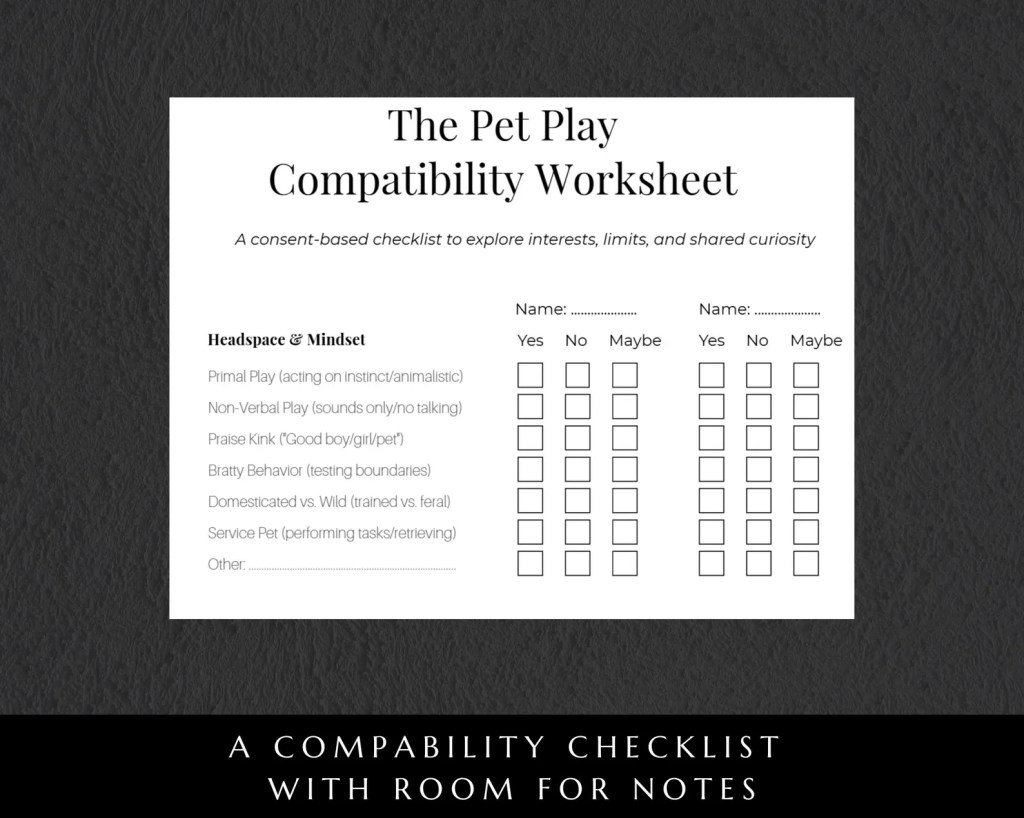
You can use it on your own to explore your preferences or complete it separately with a partner and compare your answers afterward.
View the Non Sexual Pet Play Yes/No/Maybe Checklist on Etsy
Your List Is Allowed to Change
One of the mistakes people can make with BDSM checklists is treating them as permanent declarations of identity. They aren’t.
Experience changes things. Relationships change things. Learning more about an activity can change your opinion in either direction.
Something that sounded intimidating when you first encountered BDSM might become interesting once you understand it better. Something you initially loved in theory might turn out not to suit you at all.
You are also allowed to enjoy something once and decide you don’t want to do it again. Your Yes/No/Maybe list should reflect where you are now, not lock you into the answers you gave six months ago.
A Checklist Is the Beginning of the Conversation
A BDSM Yes/No/Maybe list can’t tell you exactly what kind of submissive, dominant, switch, pet, handler, or kinky person you are.
What it can do is give you a structured way to start figuring that out.
Use it to notice patterns. Question your Maybes. Add conditions to your Yes answers. Respect your No answers. If you are using the list with somebody else, treat their answers with the same respect.
Most importantly, don’t worry about creating the “perfect” list. The useful part isn’t how many boxes you tick. It’s having a clearer understanding of your interests, boundaries, and the conversations you want to have next.
Stay curious, stay safe,
HBJ





 The Kink Archives
Plaats een reactie