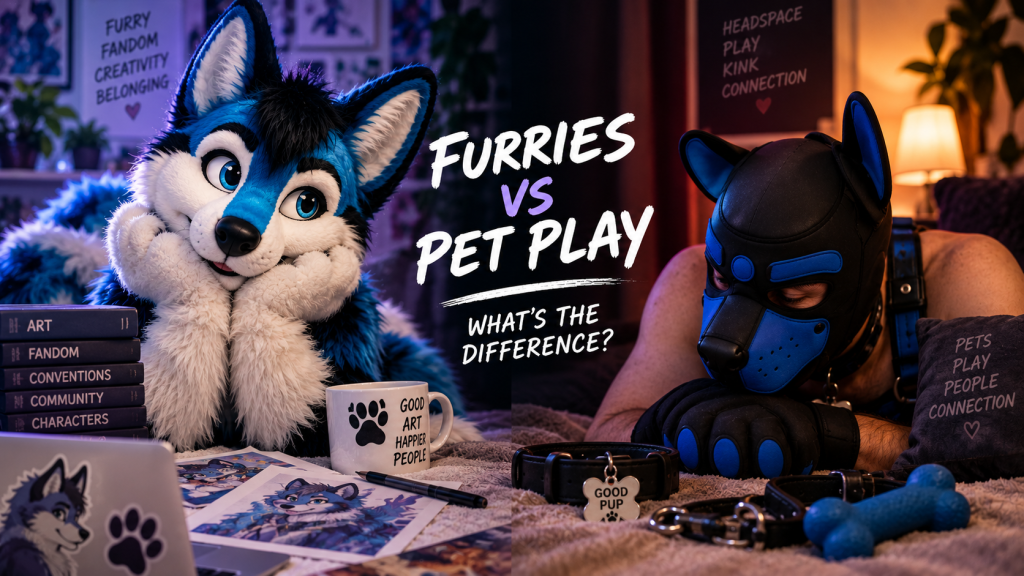
At first glance, furries and pet play can look like they belong to the same world. Both can involve animal identities, ears, tails, masks and people giving themselves animal names, and there are definitely people who are involved in both communities, so I can understand why they get mixed up.
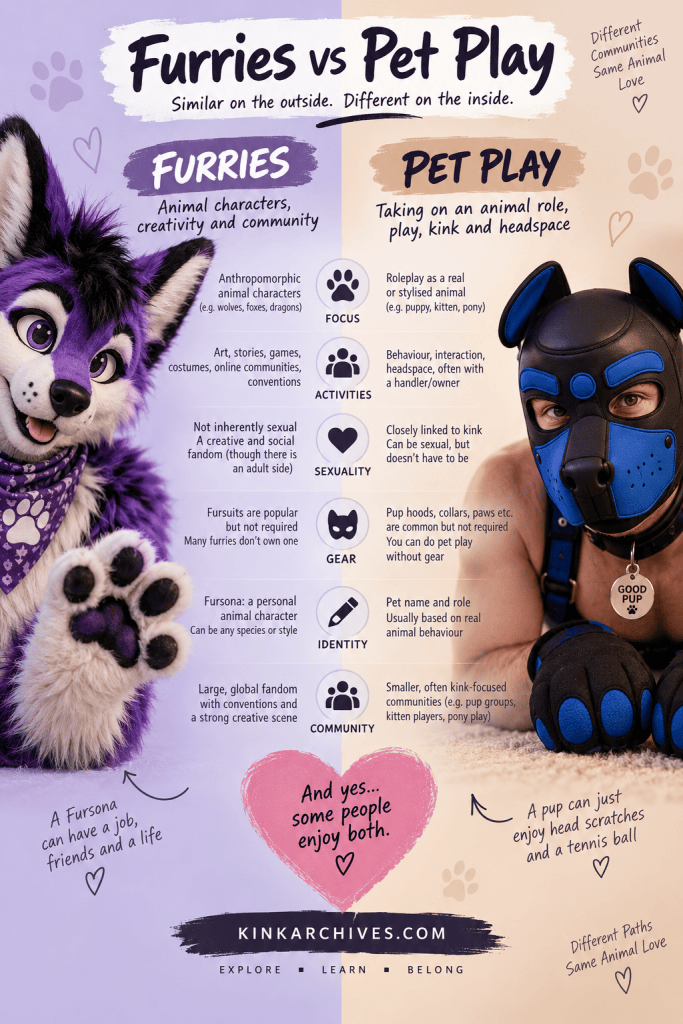
They are not actually the same thing though. The easiest way to explain the difference is that furry is mainly about an interest in anthropomorphic animal characters, while pet play is about taking on the role or behaviour of an animal. Once you look beyond the ears and tails, that difference becomes much clearer.
A furry isn’t usually pretending to be a pet
Furry fandom is centred around anthropomorphic animals, basically animals that have human characteristics. They might walk on two legs, talk, wear clothes, have jobs and relationships, or live in completely fictional worlds. They are animal characters, but they don’t necessarily behave anything like real animals.
Many furries have a fursona, which is an animal character they have created to represent themselves in some way. That character might share parts of their personality, be an exaggerated or idealised version of themselves, or simply be a character they enjoy. There aren’t many limits to what a fursona can be either, so a pink wolf with piercings and a love of heavy metal is perfectly possible! Nobody is going to complain that real wolves don’t do that.
Pet play tends to work in a different direction. Someone doing puppy play isn’t necessarily creating a fictional dog character with a detailed personality and backstory. They are more likely to be interested in what it feels like to behave like a puppy, be treated as one, or enter the particular headspace that comes with the role.
That might involve crawling instead of walking, barking instead of talking, playing with toys, responding to commands or simply curling up next to a handler and enjoying the attention. It doesn’t have to involve all of those things, but the animal behaviour itself is usually much more important.
I quite like looking at the difference this way: furry often gives animals more human characteristics, while pet play can give a person permission to leave some of their human behaviour behind for a while.
You don’t need a fursuit to be a furry
I think the costumes are responsible for a lot of the confusion because fursuits are probably the most visible part of furry culture to outsiders. They can be incredibly detailed, with custom colours, markings and facial features designed around someone’s particular character, but plenty of furries don’t own one at all.
Someone can be interested in furry artwork, have a fursona, spend time in furry communities and attend conventions without ever putting on a fursuit. The suit is one way of physically becoming or portraying a character, rather than something you need before you’re allowed to call yourself a furry.
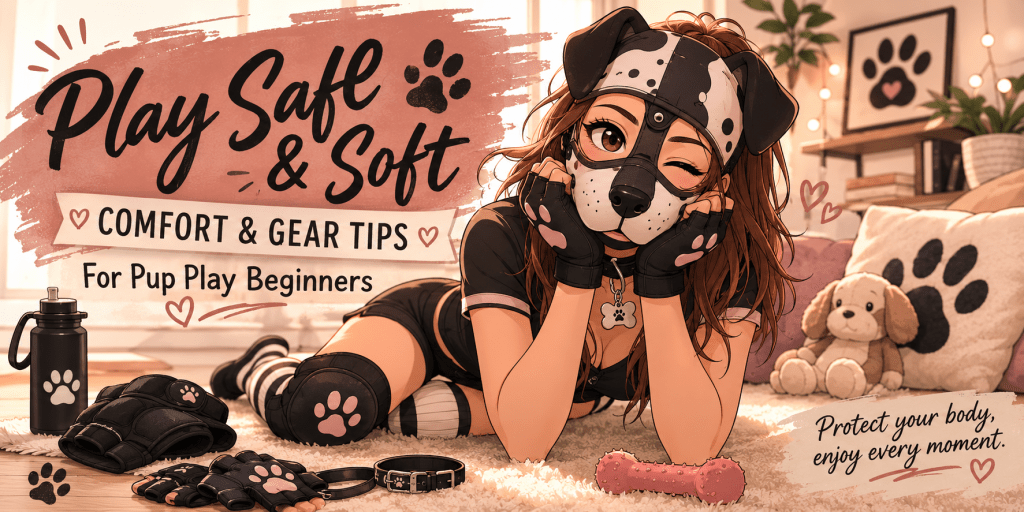
Pet play doesn’t require gear either. You don’t need a puppy hood to be a pup, and you don’t need ears and a tail to try kitten play. When people do use gear, however, it can serve a slightly different purpose.
A puppy hood can help someone get further into the animal role, while paws or mitts make using your hands normally more difficult. A collar might be part of the pet/handler relationship, and a leash can become part of the interaction itself. The gear isn’t just representing what the animal looks like; it can change how the person wearing it moves, behaves or feels.
Of course there is plenty of overlap here. Some pet players have very elaborate and personalised gear, while some furries enjoy the feeling of transformation that comes from wearing a suit. These aren’t strict rules, just useful ways of understanding why two things that look similar from the outside can have quite different meanings to the people wearing them.
Pet play has a much stronger connection with kink
This is probably the biggest reason the distinction matters on KinkArchives. Pet play has a fairly obvious connection with BDSM, particularly when there is a pet and handler or owner dynamic involved. There can be commands, training, rewards, rules, collars, leashes and different forms of control, and for someone who enjoys submission that relationship can be a large part of the attraction.
Pet play can also be sexual, although it doesn’t have to be. Someone might find being controlled, trained or treated as an animal erotic, while somebody else is much more interested in the headspace, affection or playfulness. The same person might enjoy both depending on the situation.
Furry fandom isn’t inherently a kink. There is an adult and sexual side to furry culture, including erotic artwork and sexual roleplay, and some people incorporate furry characters or their fursona into their sex lives. There is also an overlap between furry, BDSM and other kink communities.
That still doesn’t make being a furry a fetish by default. For plenty of people, furry is primarily about art, characters, creativity, friendship, conventions and community, with little or no sexual element involved.
This is worth mentioning because furry has been heavily sexualised by people outside the fandom, and reducing the whole thing to sex gives a fairly distorted picture of what the community actually is.
Pup play is where things get a little blurrier
Pup play makes the distinction particularly interesting because pup culture has developed a strong identity and community around it. Pups can have names, personalised hoods, colours, groups and social events, and someone can identify strongly with their pup persona outside a formal BDSM scene.
At that point, it can start to look quite similar to someone having a fursona. The visual difference isn’t always particularly helpful either, especially when modern pup hoods can be colourful and expressive and are combined with tails, paws and other animal-inspired gear.
The communities can overlap as well. Someone can have a furry wolf character and also enjoy puppy play with a handler, and those two things don’t need to compete with each other. One might be a creative or social identity while the other is connected to kink, submission or a particular headspace, or the person might mix the two together in their own way.
That’s fairly normal when you look at subcultures more generally. Communities don’t develop in complete isolation from each other, and people certainly don’t restrict themselves to one interest because it makes the definitions easier for everybody else.
So what is actually the difference?
Rather than looking at what somebody is wearing, I think it makes more sense to look at what the animal means to them.
A furry might have a fox character that represents them online, appears in artwork and has its own personality and appearance. Someone into pet play might be their handler’s puppy and enjoy the behaviour, relationship or headspace that comes with taking on that role. Both involve an animal identity in some sense, but they’re approaching it from quite different directions.
Even that distinction isn’t perfect, because people are free to combine these things however they want. A furry can enjoy behaving like their animal, a pet player can develop a very detailed pup identity, and someone can comfortably belong to both communities.
The important thing is that furries and pet players aren’t simply two names for the same group of people. Furry is a much broader fandom built around anthropomorphic animal characters, while pet play is a practice with much stronger roots in kink and roleplay.
They just happen to share quite a lot of ears, tails and people who don’t mind being mistaken for one another occasionally.
I really hope this helped seeing the differences between Furries and Pet Play. Either way, you are allowed to go for one, or for both!
Stay curious, stay safe,
HBJ


 The Kink Archives
Plaats een reactie